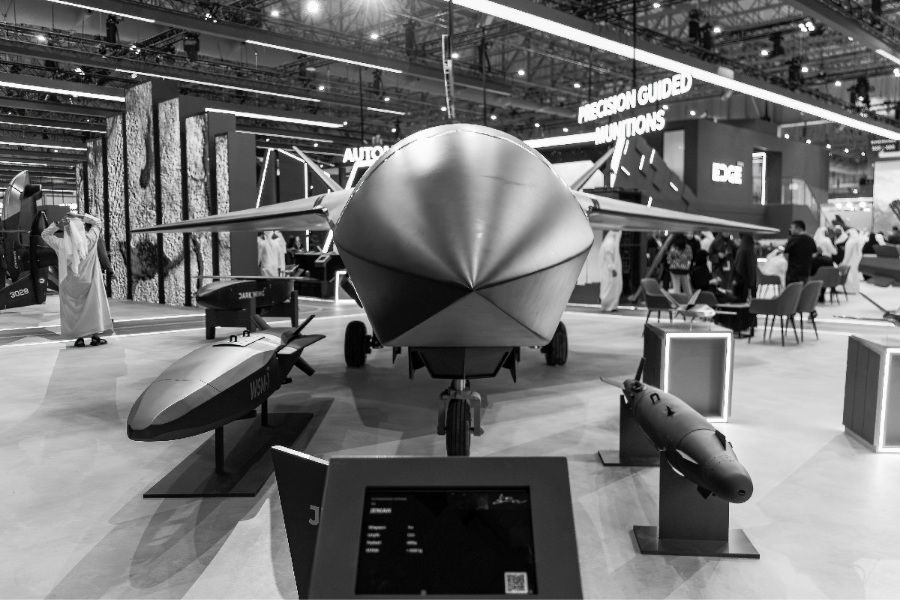
Florida’s Autonomous Defense Advantage

How a decade of economic transformation, technological diversification and defense-sector growth positioned Florida to become a national center for autonomous warfare.

Florida’s economic identity is changing faster than its traditional image suggests. From 2014 to 2024, the state’s current-dollar GDP increased from approximately $860 billion to $1.73 trillion. Even after inflation, output grew roughly 49 percent. Professional and technical services, transportation, construction and manufacturing all expanded substantially, creating an economy increasingly shaped by technology, logistics and advanced production—not simply tourism, real estate and population growth. (Florida Policy Index; Federal Reserve Economic Data)
Autonomous warfare is one of the clearest expressions of that transformation. FloridaCommerce estimates that the state’s military and Autonomous Defense sector supports more than 865,000 direct and indirect jobs and generates $102.6 billion in annual economic activity. In fiscal year 2024, Florida ranked fourth nationally in both Department of Defense contract spending—$25.2 billion—and defense personnel spending—$9.3 billion.
Autonomous defense is making that footprint more strategically valuable. At Eglin Air Force Base, modified F-16s are testing artificial-intelligence agents through the VENOM autonomy program, while the installation’s Autonomy Proving Ground gives emerging companies access to military aircraft, ranges and testing environments. In Panama City, the Navy is developing a new subsea and seabed warfare facility dedicated to research and testing of autonomous unmanned systems.
The policy implication is straightforward. Autonomous systems require more than defense installations. They depend on secure supply chains, electronics manufacturing, reliable energy, specialized workers, protected testing ranges and faster coordination among government, universities and industry.
Florida has spent the last decade becoming larger and more technologically diverse. The next question is whether it will remain primarily a host for federal defense activity—or become a national center for designing, producing and integrating autonomous systems. The infrastructure is already here. Converting it into durable industrial leadership is now a matter of policy.
References and Data Sources for "Florida’s Autonomous Defense Advantage" are included below:
U.S. Bureau of Economic Analysis, Real Gross Domestic Product: All Industry Total in Florida, accessed through Federal Reserve Economic Data.
The Aleksander Group, Florida’s $1.7 Trillion Economy: A Decade of Economic Transformation, drawing on BEA industry-level GDP data.
FloridaCommerce Office of Military and Defense, Military and Defense in Florida.
U.S. Department of Defense, Office of Local Defense Community Cooperation, Defense Spending by State—Fiscal Year 2024.
U.S. Air Force, VENOM Program Progresses to Piloted Flights and Autonomy Tests, Eglin Air Force Base.
U.S. Air Force, Autonomy Proving Ground Advances With First Alternative-Navigation Flight, Eglin Air Force Base.
Naval Sea Systems Command, NSWC Panama City Division Breaks Ground on Facility for Autonomous Innovation.
Methodological Note: Current-dollar GDP figures measure changes in economic scale and include the effects of inflation. Real GDP is used when describing inflation-adjusted growth. FloridaCommerce economic-impact estimates and Department of Defense spending figures measure different activity and should not be added together.